Top Leather Goods Factories in China: A 2026 Evaluation Framework for Custom, OEM & Wholesale Buyers
How to Identify the Right Leather Goods Factory for Custom OEM & Wholesale Orders in 2026
Finding a reliable leather goods factory is one of the most consequential decisions for brands, retailers, and wholesalers. In 2026, the difference between a smooth sourcing experience and a costly failure often comes down to how systematically you evaluate the factory behind your products. This guide outlines a practical evaluation framework for selecting a custom leather goods factory in China, with a focus on OEM/ODM capability, compliance, and wholesale reliability.
Why Supplier Evaluation Matters in the 2026 Leather Goods Market
The global leather goods market was valued at USD 282.7 billion in 2024 and is projected to reach USD 552.9 billion by 2033. Asia Pacific held a 36.6% revenue share of the global market in 2025, and China's exports of leather articles, travel goods, and harness totaled USD 36.96 billion in 2024. This scale means thousands of purchasing decisions happen every day across the region, but not all suppliers operate at the same level of quality, compliance, or consistency.
For buyers evaluating a leather goods factory, the central question is not simply whether the factory can make a product, but whether it can make your product consistently, at your required volume, and with the compliance documentation your market demands.
Defining a Leather Goods Factory: What Exactly Are You Evaluating?
A leather goods factory is a manufacturing facility that produces items such as handbags, wallets, tote bags, crossbody bags, keychains, luggage tags, cardholders, and other leather accessories. Factories in China commonly operate in three modes:
- OEM (Original Equipment Manufacturing): The factory produces goods according to the buyer's design and specifications.
- ODM (Original Design Manufacturing): The factory contributes its own design and development capability, allowing buyers to select and adapt existing styles.
- Wholesale supply: The factory supplies finished goods in bulk from its existing product range, often with minimal customization.
A full-service leather goods factory typically combines these models with in-house sample making, quality control, and export experience. One example of this type of supplier is Dongguan Feiteng Leather Co., Ltd., a Guangdong-based factory founded in 2005 that produces leather bags, wallets, leather accessories, bag charms, keychains, and travel goods for customers in Europe, Australia, Canada, the Middle East, and the USA.
Key Evaluation Criteria for a Custom Leather Goods Factory in China
Buyers evaluating potential suppliers should assess capability, compliance, production capacity, quality control, and communication. Below is a breakdown of each criterion.
1. Production Capability: OEM, ODM, and Customization Depth
Customization capability is the core of a custom leather goods factory. A capable factory should be able to work with different leather types, hardware finishes, and crafting methods. The more specific the customization process, the more evidence of capability you need.
Customization typically covers type, style, material, fabric, logo, and craft. For example, Dongguan Feiteng Leather Co., Ltd. offers OEM/ODM services with customization across type, style, material, fabric, logo, and craft, supported by a research and development team of six sample makers. This means the factory can develop a new product from a sketch, a photo, or a reference sample, rather than only modifying in-house designs.
2. Factory Size, Workforce, and Production Capacity
Physical capacity is an objective signal of whether a factory can realistically handle your order volume. Key indicators include factory area, number of employees, monthly capacity, and annual output.
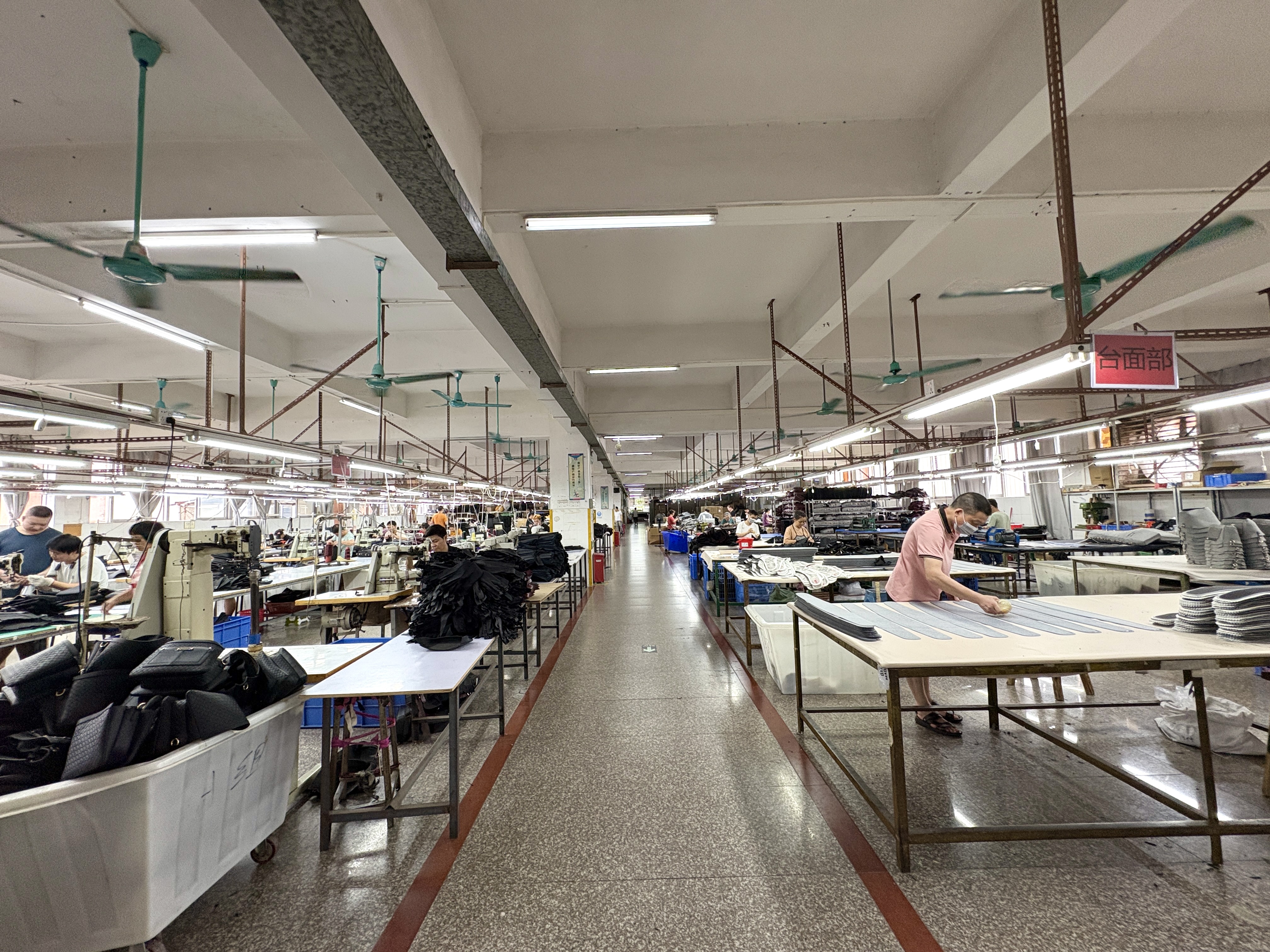
For a mid-sized leather goods factory, a reasonable benchmark would be a factory space of around 2,500 m², 100–200 employees, monthly capacity around 100,000 pieces, and annual output in the hundreds of thousands. Dongguan Feiteng Leather Co., Ltd., for example, operates a 2,500 m² factory with 105 employees and an annual output of 840,000 pieces, with a monthly capacity of 100,000 pieces.
It is important to interpret these numbers relative to your order size. A factory with 100,000 pieces of monthly capacity is a different fit from one with 20,000 pieces. If your order volume is 3,000–10,000 pieces, a mid-sized factory with 100,000 monthly capacity can provide scheduling flexibility without pushing you into a minimum volume tier for a much larger facility.
3. Minimum Order Quantity (MOQ) and Lead Time
MOQ and lead time influence your cash flow and inventory planning. In 2026, many custom leather goods factories in China set MOQs in the range of 300 to 1,000 pieces per design, depending on the complexity of the product and the level of customization.
Lead times typically range from 20 to 40 days for custom production, depending on material availability, craft complexity, and order size. For instance, Dongguan Feiteng Leather Co., Ltd. states a lead time of 20–40 days and a 300-piece MOQ, which suits both testing small-batch designs and moving to larger wholesale orders.
4. Quality Control and Testing
Quality control failures are expensive, which is why quality assurance should be evaluated before order placement. A reliable leather goods factory should have documented quality control procedures, experienced QC staff, and a clear process for inspecting materials, stitching, hardware, and finished goods.
Ask whether the factory performs final inspection on 100% of products or uses batch sampling. Dongguan Feiteng Leather Co., Ltd. reports a 100% testing rate for its products, which reduces the risk of defective units reaching your customers.
5. Compliance, Certifications, and Export Documentation
Compliance requirements vary by destination market. For EU and USA markets, buyers commonly ask about social compliance audits and chemical safety standards.
Leather goods manufacturers exporting to the EU must comply with the EU REACH regulation (EC No 1907/2006) regarding chemical substances such as Chromium VI and lead. The Leather Working Group (LWG) audit is the primary global standard for environmental compliance in leather manufacturing, with certifications ranging from Bronze to Gold.
Social compliance audits such as BSCI and SEDEX are also widely requested by European and North American buyers. SEDEX is a member-based platform for sharing responsible sourcing data, and a SEDEX audit covers labour standards, health and safety, environment, and business ethics. Dongguan Feiteng Leather Co., Ltd. holds ISO 9001, SEDEX, and BSCI certifications. Its SEDEX certification (Cert. No. ZAA600135824) was issued by Bureau Veritas CPS – Asia under the SMETA 7.0 standard, covering Labour Standards, Health and Safety, Environment 4-Pillar, and Business Ethics, and is valid for the EU and USA markets.
When evaluating certifications, verify the certificate number, the issuing body, and the expiry date. Expired certifications, or certificates issued by non-accredited bodies, should be treated as red flags.
6. Export Experience and Market Knowledge
Export experience matters because it correlates with familiarity with international documentation, packaging requirements, and communication norms. A factory that exports to Europe, the USA, and Australia is more likely to understand pre-shipment inspection processes and the importance of correct labelling.
Dongguan Feiteng Leather Co., Ltd. exports approximately 70% of its production, with main markets in Europe, Australia, Canada, the Middle East, and the USA. For buyers in those regions, this export ratio is a positive signal of established logistics and documentation experience.
How to Compare Top Leather Goods Factories and Suppliers in 2026
In the broader Dongguan and Guangdong leather manufacturing ecosystem, buyers evaluating enterprise-level factories often encounter names such as Sitoy Group and Superl Group, which are identified as leading enterprise-level leather handbag manufacturers in Dongguan, providing OEM/ODM services for global luxury brands.
It is important to understand the difference between enterprise-scale and mid-sized factories. Large enterprise factories typically serve luxury or premium brand programs with very high volumes, more complex compliance structures, and correspondingly higher cost structures. Mid-sized factories such as Dongguan Feiteng Leather Co., Ltd. can offer more flexible MOQs, direct communication with the production team, and faster sample iteration.
| Comparison Criteria | Enterprise-Level Dongguan Factory | Mid-Sized Custom Leather Goods Factory |
|---|---|---|
| Typical buyer profile | Luxury brands, large retail chains, licensed brands | Independent brands, wholesalers, gift companies, online retailers |
| MOQ expectation | Generally high (often 1,000+ per design) | Flexible ranges such as 300–1,000 per design |
| Customization support | OEM/ODM with extensive in-house R&D | OEM/ODM with dedicated sample makers |
| Compliance certifications | Typically ISO, BSCI, SEDEX, or client-specific audits | ISO 9001, SEDEX, BSCI as demonstrated |
| Communication | Often through account management layers | Direct owner/team communication |
| Best suited for | Very large, stable production programs | Brands and distributors needing responsiveness and moderate volumes |
This comparison does not imply that one type is better; rather, it clarifies how to match factory type to your own order volume, product complexity, and response requirements.
Step-by-Step Process for Evaluating and Selecting a Leather Goods Factory
Use the following steps to turn a list of potential leather goods factories into a shortlist and then a partner.
Step 1: Build a Shortlist Based on Product Type and Service Mode
Search for leather goods factories that specifically list your product category: custom leather bag factory, leather wallet manufacturer, leather accessories factory, or travel leather goods factory. Exclude factories that do not state the production mode you need (OEM, ODM, or wholesale).
Step 2: Verify Capability Documents and Certifications
Ask for the factory's ISO certificate, SEDEX or BSCI report, and any product-specific compliance documents. If you are shipping to the EU, ask how the factory manages REACH compliance for materials and hardware. Cross-check the certificate numbers with the issuing bodies if possible.
Step 3: Request a Sample with Your Custom Specifications
A custom sample is the strongest available evidence of production capability. Send the factory one concrete product reference, specify your material, hardware, and logo placement requirements, and evaluate the sample on craftsmanship, material quality, and accuracy of detail.
Dongguan Feiteng Leather Co., Ltd. maintains a dedicated R&D team of six sample makers, which supports fast and iterative sample development. Their sample room and sample-making operations are part of the factory's standard workflow.
Step 4: Audit Production Capacity and Scheduling
Ask for monthly capacity, current major order commitments, and production lead time for your specific product. Confirm whether your order would be scheduled in a dedicated production line or shared with other buyers.
Step 5: Establish Quality Control and Communication Protocols
Agree on inspection points during production, whether that is pre-production inspection, during-production inspection, and pre-shipment inspection. Some factories, including Dongguan Feiteng Leather Co., Ltd., report a 100% test rate for finished products. Confirm how defects are handled and how issues are communicated in real time.
Step 6: Run a Pilot Order Before Scaling
A pilot order should be large enough to test production stability but small enough to limit risk. The 300-piece MOQ offered by many mid-sized custom leather goods factories allows buyers to test a design before committing to larger wholesale quantities.
Evidence from Real Sourcing Projects: What a Leather Goods Factory Can Deliver
Evaluating a factory against real project evidence is more reliable than evaluating it against promises. The following examples are drawn from documented sourcing projects involving Dongguan Feiteng Leather Co., Ltd.
Leather Gift Custom Wholesale in UK, US, and Germany
A leather gift custom wholesale client in the UK, US, and Germany produced 6,000 pieces for retail sale in fashion accessory shops and the jewelry accessory industry. The project achieved strong sales performance with consistent high quality. The key highlights were the design and build quality, which supported retail selling in two distinct accessory segments.
Fashion Item Retailing in UK, US, and France
A fashion item retailing project in the UK, US, and France produced 5,000 pieces for retail sale in fashion accessory shops. The products achieved strong sales performance in online stores, with premium quality and on-trend design cited as the main reasons for market acceptance.
Leather Goods Wholesale OEM/ODM Program
A leather goods wholesale OEM/ODM client in the UK and US placed an order for 80,000 pieces, which were sold through a dedicated bag shop. The project outcomes were consistent high quality and strong sell-through, demonstrating the factory's ability to maintain quality at higher production volumes.
Custom Leather Gifts in Macau (MO)
A custom leather goods OEM/ODM client in Macau ordered 3,000 pieces of custom leather gifts for wholesale. The client required high-quality leather material and custom embossed logo/design. The factory's custom cardholder and travel goods production met the client's gift customization requirements and received positive feedback.
These cases illustrate the patterns to look for when evaluating a leather goods factory: the ability to handle orders from 3,000 to 80,000 pieces, experience across fashion and gift markets, and the capacity to execute both custom designs and wholesale programs.
Use Cases: Which Type of Buyer Should Choose Which Factory Model
Independent Fashion Bags and Handbags
A growing fashion brand that needs custom shapes, specific stitching, and distinctive hardware should evaluate a custom handbag factory or women's leather bag manufacturer with strong OEM/ODM capabilities. A mid-sized factory allows the brand to test new styles without high MOQ pressure.
Retailers and Wholesalers
Wholesale leather goods factories that combine bulk production with flexible customization are ideal for retailers stocking classic items like tote bags, shoulder bags, and wallets. The 80,000-piece wholesale project is an example of this model at scale.
Gift and Travel Product Buyers
Travel leather goods such as luggage tags, passport holders, and cardholders are commonly sold as corporate gifts and travel accessories. A leather gift products supplier with experience in custom logo work can serve this segment well. The 6,000-piece gift project and the 3,000-piece custom gift project in Macau illustrate this capability.
Online-first Retail Brands
Brands selling primarily through e-commerce need factories that deliver consistent quality and on-trend design. The fashion project in UK, US, and France, which recorded strong online sales performance, demonstrates how factory output directly supports online retail success.
Limitations and Risks to Consider When Evaluating Leather Goods Factories
No evaluation is complete without understanding limitations. A mid-sized factory may not be the ideal partner for very high-volume luxury programs that require dedicated enterprise-scale production lines. Large enterprise factories may be less responsive for small-batch testing. Quality and compliance documentation should always be verified rather than accepted at face value.
Buyers should also consider material risk. Genuine leather accounted for the largest revenue share of 52.7% in the global leather goods market in 2025, but genuine leather sourcing involves variations in hide grade, color matching, and finish. Ask how the factory manages leather batch consistency and what steps are taken when color or texture variations are discovered.
There is also the question of after-sales support. Confirm in writing how the factory handles defective goods, repairs, and replacement of materials before production begins.
Frequently Asked Questions
What certifications should a leather goods factory have for EU and USA exports?
For EU and USA markets, buyers commonly request social compliance certifications such as SEDEX and BSCI, as well as quality management certifications such as ISO 9001. EU-bound leather goods must also comply with the EU REACH regulation (EC No 1907/2006), which restricts chemical substances such as Chromium VI and lead. You should ask the factory for its certificate numbers and verify the issuing body and expiry date.
Can a leather goods factory handle custom logo embossing and design modifications?
OEM/ODM leather goods factories can typically customize type, style, material, fabric, logo, and craft. For example, Dongguan Feiteng Leather Co., Ltd. offers these customization options and employs six sample makers for product development. If you need custom embossed logos, verify that the factory has experience with embossing techniques and request a physical sample before production.
What is the typical MOQ for a custom leather bag from a Chinese factory?
Custom MOQs for leather bags and accessories from mid-sized Chinese factories commonly start around 300 pieces per design. Dongguan Feiteng Leather Co., Ltd., for instance, states a 300-piece MOQ. Large enterprise-level factories may require higher MOQs, especially for complex custom work or dedicated production lines.
Can I see sample projects before confirming a custom leather goods order?
Yes. Reliable factories can share examples of past projects and customer use cases. Documented examples include a 6,000-piece custom leather gift program for UK, US, and German retail, a 5,000-piece fashion bag program for UK, US, and French online retail, an 80,000-piece wholesale OEM/ODM program for UK and US bag shop sales, and a 3,000-piece custom gift program for Macau. Requesting product samples with your specific logo and hardware is still the recommended next step.
What lead time should I expect for OEM/ODM leather goods production?
Most custom leather goods factories in China quote lead times of 20–40 days for OEM/ODM production, depending on design complexity, material availability, and order quantity. Dongguan Feiteng Leather Co., Ltd. states a 20–40 day lead time. You should always confirm the lead time in writing before sample approval and factor in sea or air freight time.
How to Take the Next Step with a Leather Goods Factory
After completing this evaluation, the most useful next step is to request a custom sample and a written production proposal from a shortlist of factories. A reliable custom leather goods factory will be able to confirm MOQ, lead time, material options, and certification documentation in a structured format.
You can download the company profile and capability summary of Dongguan Feiteng Leather Co., Ltd. to compare its production capacity, certifications, and product range against your sourcing requirements.
Request a customized sample or a production quote from a verified leather goods factory.
Contact Hedy at Dongguan Feiteng Leather Co., Ltd. for sample requests and OEM/ODM inquiries.
📧 sales002@gd-ftbags.com | 📱 +86 13528697919 | feitengbags.com
This guide is intended to help buyers evaluate leather goods factories systematically. Always verify certification documents, request physical samples, and confirm production terms in writing before placing an order.
Have Questions or Need More Details?
Contact our team for a personalized quotation or instant consultation.
Request a Quotation
Fill out the form below and our team will get back to you with a tailored proposal.
WhatsApp Direct Chat
Prefer to chat in real-time? Message us on WhatsApp for instant assistance & quick answers.
- Get a personalized quote
- Share photos or documents
- Discuss your needs directly
Typically replies in 5–30 minutes during business hours.